
LiDAR vs Radar — Why Wavelength Matters in Low-Visibility Environments
June 3, 2026
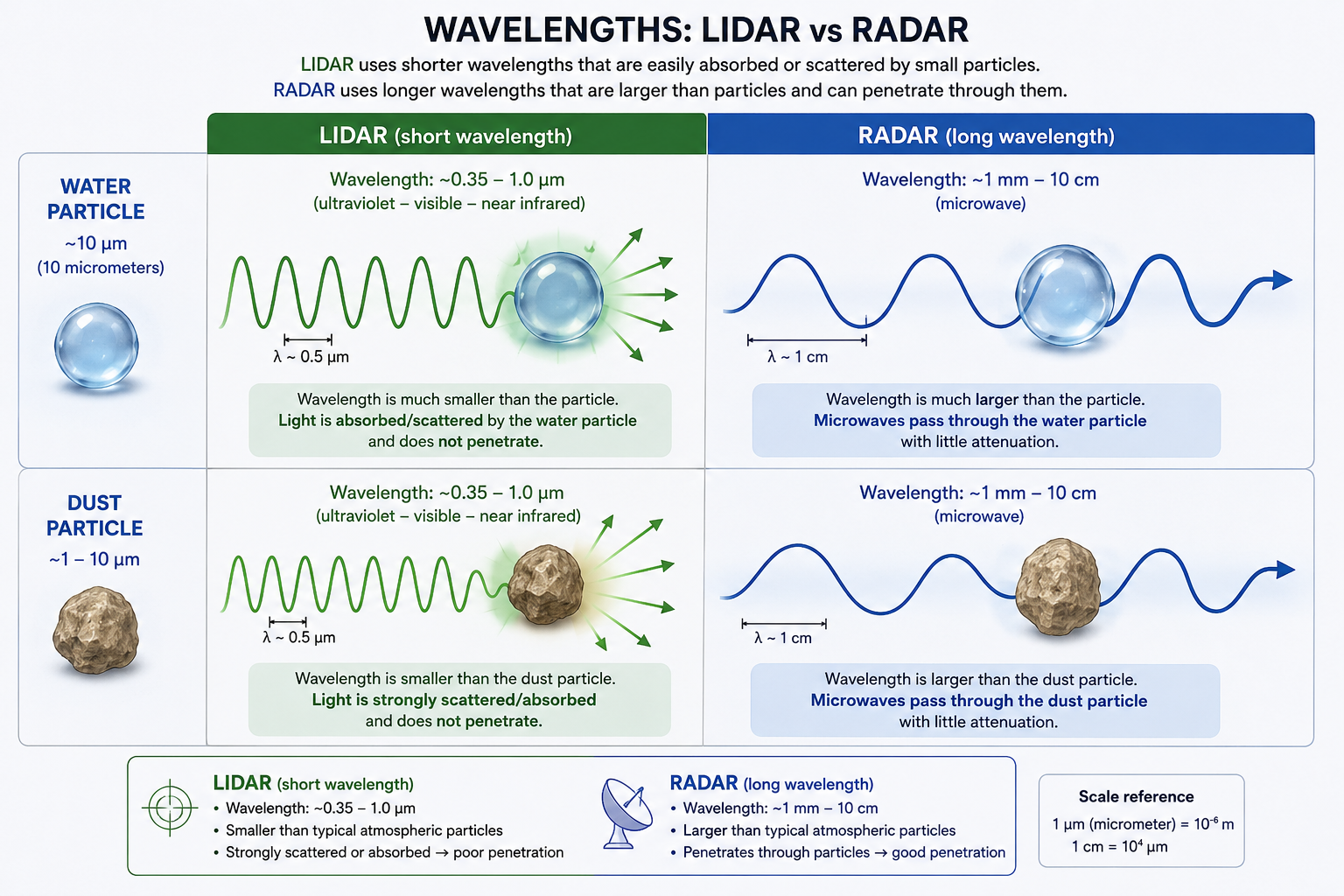
Understanding how electromagnetic wavelengths interact with particles is critical when deploying sensing technologies in harsh, real-world conditions. Radar and LiDAR systems operate on fundamentally different parts of the electromagnetic spectrum, and this difference directly determines their performance in environments filled with water droplets, dust, smoke, or debris.
LiDAR (Light Detection and Ranging) uses short wavelengths, typically in the visible to near-infrared range (around 0.3–1.0 µm). These wavelengths are comparable to or smaller than common atmospheric particles such as dust (1–10 µm) and water droplets (~10 µm). As a result, LiDAR signals are strongly scattered or absorbed when they encounter these particles 1. This leads to signal attenuation, reduced range, and degraded accuracy in environments with fog, rain, smoke, or airborne dust. Moreover, dust accummulation within the LiDAR sensor leads to degraded measurements, preventing robots from accurately measuring the environment.
Radar (Radio Detection and Ranging) 2, in contrast, operates at much longer wavelengths 3, typically in the millimeter to centimeter range (1 mm to 10 cm). These wavelengths are significantly larger than most environmental particles. Because of this size mismatch, radar waves are less affected by scattering and can penetrate through dust clouds, fog, rain, and even foliage with relatively low attenuation.
This physical distinction becomes critical in GNSS-denied and harsh environments where robots cannot rely on satellite positioning.
Mining and Quarry Operations
Mines and quarries are characterized by dense dust clouds generated by drilling, blasting, and heavy machinery. LiDAR systems struggle in these conditions because dust particles scatter the laser light, reducing visibility and accuracy. Radar systems, however, maintain reliable detection and ranging, enabling safer navigation of autonomous vehicles and better monitoring of equipment and terrain.
Airports and Aviation Safety
Airports must operate in all weather conditions, including heavy fog, rain, and snow. LiDAR-based systems can lose effectiveness in low-visibility scenarios due to scattering by water droplets 4. Radar, with its longer wavelengths, penetrates these conditions effectively, making it essential for aircraft detection, ground movement monitoring, and collision avoidance systems.
Forestry and Wildfire Environments
Forests present complex environments with foliage, humidity, smoke 5, and airborne particles. During wildfires, smoke particles severely degrade LiDAR performance 6. Radar systems can penetrate smoke and partial vegetation cover, providing more consistent detection of terrain, obstacles, and movement. This capability is critical for firefighting operations, surveillance, and autonomous navigation in forested areas.
Industrial and Harsh Outdoor Settings
In environments where airborne particulates fluctuate rapidly—such as construction sites, ports, and heavy industry—sensor reliability becomes a limiting factor. LiDAR offers high-resolution mapping in clear conditions but becomes unreliable when particle density increases 7. Radar provides robust, lower-resolution sensing that remains stable regardless of environmental interference.
Conclusion
The wavelength difference between LiDAR and radar is not a minor technical detail; it defines their operational limits. LiDAR excels in clean environments where high precision is required, while radar dominates in harsh, particle-rich conditions where penetration and reliability are critical. Modern sensing systems increasingly combine both technologies to balance resolution and robustness, ensuring performance across a wide range of environmental conditions.